Ваша корзина пуста...

 0
Сравнивать
0
Сравнивать
 Пользователь
 0
Корзина
0
Корзина
Depending on the type of contaminant sampled and the method, there are several types of filter materials to choose from that are inserted into the sampling device. Filters are evaluated gravimetrically, microscopically, or are mineralized, in case the content of any of the components is determined by a spectral analytical method.
Depending on the type of contaminant sampled and the method, there are several types of filter materials to choose from that are inserted into the sampling device. Filters are evaluated gravimetrically, microscopically, or are mineralized, in case the content of any of the components is determined by a spectral analytical method. A regular filter usually has two sides – glossy (smooth) and matte (rough). According to the end, the filters can be rotated in the sampler. If you are going to evaluate sampling using a microscope, use the shiny side, and if you are going to evaluate sampling gravimetrically, use the rough side, which captures dust particles more effectively.
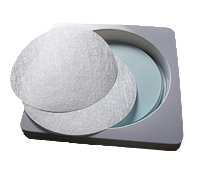
Standard filters for most aerosol sampling in industrial hygiene applications. The material is a mixture of pure and biologically inert cellulose acetate (CA) and cellulose nitrate (NC). They resist dilute acids and hydroxides, aromatic and aliphatic hydrocarbons. These filters do not have well-defined pores, but work like a sieve. Particles are captured by the passage of the pumped air in the intricate winding paths of these materials, and as the particles collide and are captured in the filter cavities, their capture increases. The pore size of these filters does not actually reflect their exact size (as with capillary filters), but is rather used to categorize these materials for uniformity of determination. MCE dissolves easily and without residue in dilute nitric acid, making it ideal for AAS analysis (the most commonly used filter is the 25mm support pad filter with 0.8 µm pores used in the IOM sampler). The material's structure breaks down when exposed to acetone vapors and provides minimal interference with fiber counting, making it an ideal material for asbestos and other fiber sampling. They are also used for special applications for the determination of certain pesticides and fluorides. Filters are sold as individual sections as well as in cassettes (for example, for asbestos sampling).
| Марка: | |
| Категория: | Лабораторные приборы и аксессуары / Фильтрация / Мембранные фильтры |
| Диаметр фильтра | 25mm |
| Porosity | 0.8µm |
| Mатериал мембраны | MCE |
| Стерильность | Нестерильные |
| Сетка фильтра | Без сетки |