
 0
0
 0
0
Your basket is empty...
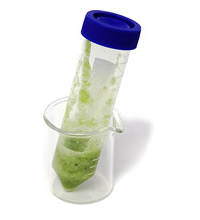 Quick, Easy, Cheap, Effective, Rugged, and Safe, the QuEChERS ("catchers") method is based on work done and published by the US Department of Agriculture Eastern Regional Research Center in Wyndmoor, PA.(1) Researchers there were looking for a simple, effective, and inexpensive way to extract and clean pesticide residues from the many varied sample matrices with which they routinely worked. They had been using the Modified Luke Extraction Method, which is highly effective and rugged, but is both labor and glassware intensive, leading to a relatively high cost per sample. Solid phase extraction also had been effective, but the complex matrices the investigators were dealing with required multiple individual cartridges and packings to remove the many classes of interferences, adding costs and complexity to the process. A new method would have to remove sugars, lipids, organic acids, sterols, proteins, pigments and excess water, any of which often are present, but still be easy to use and inexpensive.
The researchers developed a simple two-step procedure. First, the homogenized samples are extracted and partitioned, using an organic solvent and salt solution. Then, the supernatant is further extracted and cleaned, using a dispersive SPE technique. Multiple adsorbents are placed in a centrifuge tube, along with the 1mL of organic solvent and the extracted residues partitioned from step 1. The contents are thoroughly mixed, then centrifuged, producing a clean extract ready for a variety of GC or HPLC analytical techniques.(2) Validation and proficiency data for the QuEChERS method are available for a wide variety of pesticides in several common food matrices at www.quechers.com.
Using the dispersive SPE approach, the quantity and type of adsorbents, as well as the pH and polarity of the solvent, can be easily adjusted for differing matrix interferences and "difficult" analytes. Results from this approach have been verified and modified at several USDA and Food and Drug Administration labs, and the method now is widely accepted for many types of pesticide residue samples.
Restek products make this approach even simpler. The centrifuge tube format, available in 2mL and 15mL sizes, contains magnesium sulfate (to partition water from organic solvent) and PSA* adsorbent (to remove sugars and fatty acids), with or without graphitized carbon (to remove pigments and sterols) or C18 packing (to remove nonpolar interferences). Custom products are available by quote request. If you are frustrated by the time and cost involved with your current approach to pesticide sample cleanup, we suggest you try this simple and economical new method.
We have products compliant with AOAC, Multi-miniresidue and Draft European methods.
Inforamtion about products is available here.
References:

| Phase | Particle size (µm) | Pore Size (A) |
|---|---|---|
| Silica | 45 | 60 |
| C2 | 45 | 60 |
| C8 | 45 | 60 |
| C8+SCX* | 45 | 60 |
| C18 | 45 | 60 |
*C8+SCX BINS are labelled as M1.
The BINs can be used up to 40 - 100 extractions. General preparation time is 1 - 2 minutes.
 Chromatography, either GC, HPLC, SPE, FLASH or preparative, uses many types of stationary phases. Here you wil find detailed information about stationary phases.
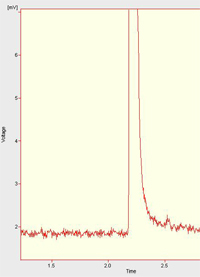 Today's laboratory needs are:
Lower detection and quantitation limits can be achieved by:
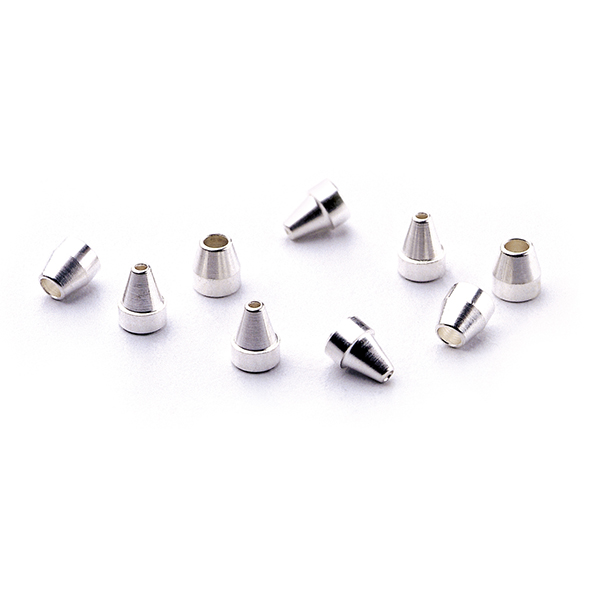 SilTite ferrules are a unique metal ferrule specifically designed for connecting fused silica GC columns and tubing to mass spectrometer interfaces and injectors. Once fitted, SilTite ferrules provide a continuous leak free connection without the need to re-tighten the nut after a few temperature cycles. SilTite ferrules make Graphite/Vespel® ferrules obsolete for use in GC-MS connections. Their performance and cost effectiveness also makes them ideal for connecting GC columns to injectors and atmospheric detectors.
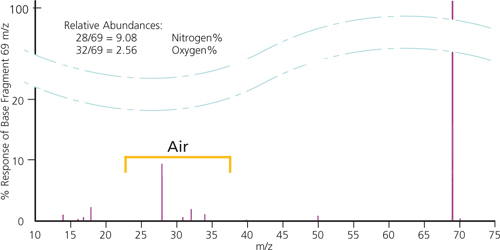
Figure 1. MS trace using a graphite Vespel ferrule after 5 temperature cycles.
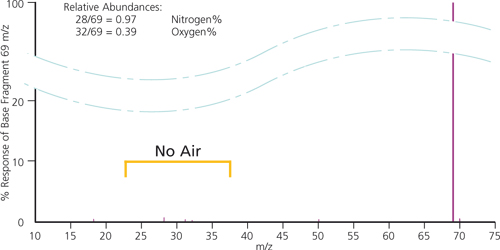
Figure 2. MS trace using a SilTite ferrule after 5 temperature cycles. (Using an MS, no leaks can be detected, even after 400 temperature cycles between 70ºC and 400ºC).
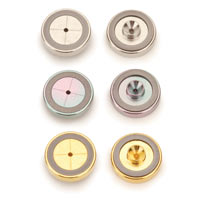 Washerless, Leak-Tight Seal for Agilent GCs ensures better tightness and easier handling than original part.
In Agilent split/splitless injection ports, it can be difficult to make and maintain a good seal with a conventional metal inlet disk. The metal-to-metal seal dictates that you apply considerable torque to the reducing nut, and, based on our testing, this does not ensure a leak-tight seal. Over the course of oven temperature cycling, metal seals are prone to leaks, which ultimately can degrade the capillary column and cause other analytical difficulties.
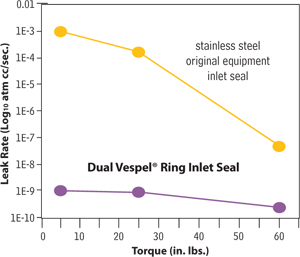
Patented Dual Vespel® Ring Inlet Seal (Restek) greatly improves injection port performance—it stays sealed, even after repeated temperature cycles, without retightening the reducing nut| This seal features two soft Vespel® rings, one embedded in its top surface and the other embedded in its bottom surface. These rings eliminate the need for a washer, and ensure very little torque is needed to make a leak-tight seal. The rings will not harm the critical seal in the injector body, or any other surface, and are outside the sample flow path. Tests using a high sensitivity helium leak detector show Dual Vespel® Ring Inlet Seals will seal equally effectively at torques from 5 in. lb. to 60 in. lb.
Why trust a metal-to-metal seal when you can make leak-tight seals quickly and easily—and more reliably—without a washer, with a Restek Dual Vespel® Ring Inlet Seal. Use a stainless steel seal for analyses of unreactive compounds. To reduce breakdown and adsorption of active compounds, use a gold-plated or Siltek®-treated seal. The gold surface offers better inertness than untreated stainless steel. Siltek® treatment provides inertness similar to that of a fused silica capillary column.
| Injector type | Instrument | Dimensions |
|---|---|---|
| Split-splitless | 7890, 6890, 6850, 5890, 5880A | 11 mm |
| Split-splitless | 5880, 5700 | 9.5 / 10 mm |
| PTV | 7890, 6890, 6850, 5890, 5880A | 11 mm |
| On-column | 7890, 6890, 6850, 5890 | 5 mm |
| Injector type | Instrument | Dimensions |
|---|---|---|
| Split-splitless | Master, GC1000 | 12 mm |
| PTV | Master, GC1000 | 12 mm |
| Injector type | Instrument | Dimensions |
|---|---|---|
| Split-splitless | Auto SYS, Auto SYS XL, 8000, 900, 990, Sigma | 11 mm |
| Injector type | Instrument | Dimensions |
|---|---|---|
| Split-splitless, PTV | 2010, 2014, 17A | "plug-septa" |
| Injector type | Instrument | Dimensions |
|---|---|---|
| Packed column | 9.5 / 10 mm | |
| 1079, 1078 | 10 / 11 mm | |
| 1177 | 9 mm | |
| 1075 / 1077 | 11 mm |
| Injector type | Instrument | Dimensions |
|---|---|---|
| Split-splitless | Trace, 8000, 8000 TOP | 17 mm |
| PTV | 8000 | 17 mm |
| Split-splitless | Trace, GC9001 | 9.5 mm |
Chromatography syringes are the finest quality precision fluid measuring devices available. With proper care and handling, syringes will provide unsurpassed performance in precision fluid measuring year after year. The life of your syringe is directly related to its cleanliness!
Some solvents, such as halogenated hydrocarbons, may attack and deteriorate the highly resistive adhesives (cements) used to affix needles and other terminations to Hamilton syringes, which may result in frozen plungers and plugged needles.

To clean Hamilton syringes, it is best to use solvents known to be effective in solvating the sample and preferably are non-alkaline, non-phosphate and non-detergent based. A biodegradable, non-phosphate, organic Cleaning Concentrate is available from Hamilton (ordering number 18311).
Rinse the syringe thoroughly after use with deionized water, acetone, or another solvent compatible with the sample. Allow the syringe to air dry. Avoid prolonged immersion of the syringe while cleaning.
We recommend to store syringes in the original packaging. This with help to protect the syringe, and allows for easy identification. Remove product description label from the end of the box, and placing it to the outside packaging. This will make re-ordering the same syringe quick and easy.
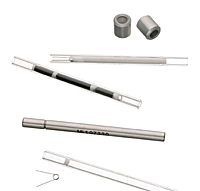 In this section you will finde informations important in the area of thermal desorption. It is quite difficult analytical technique and these informations can help you with your work with it. If you do not find required information, do not hesitate to contact our specialists.
Material emission monitoring